Tuesday, 27 September 2011

UMAR GUL

Umar Gul Biography
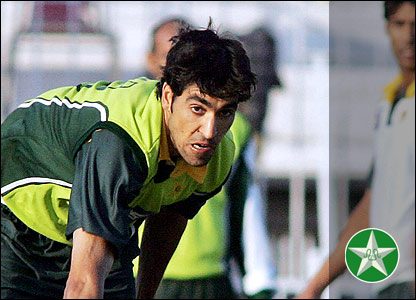
The least-hyped but most successful and assured Pakistan pace product of the last few years, Umar Gul is the latest in Pakistan's assembly-line of pace-bowling talent. He had played just nine first-class matches when called up for national duty in the wake of Pakistan's poor 2003 World Cup. On the flat tracks of Sharjah, Gul performed admirably, maintaining excellent discipline and getting appreciable outswing with the new ball.
He isn't express but bowls a very quick heavy ball and his exceptional control and ability to extract seam movement marks him out. Further, his height enables him to extract bounce on most surfaces and from his natural back of a length, it is a useful trait. His first big moment in his career came in the Lahore Test against India in 2003-04. Unfazed by a daunting batting line-up, Gul tore through the Indian top order, moving the ball both ways off the seam at a sharp pace. His 5 for 31 in the first innings gave Pakistan the early initiative which they drove home to win the Test.
Unfortunately, that was his last cricket of any kind for over a year as he discovered three stress fractures in his back immediately after the Test. The injury would have ended many an international career, but Gul returned, fitter and sharper than before in late 2005. He returned in a Pakistan shirt against India in the ODI series at home in February 2006 and in Sri Lanka showed further signs of rehabilitation by lasting both Tests but it was really the second half of 2006, where he fully came of age. Leading the attack against England and then the West Indies as Pakistan's main bowlers suffered injuries, Gul stood tall, finishing Pakistan's best bowler.
Since then, as Mohammad Asif and Shoaib Akhtar have floundered, Gul has become Pakistan's spearhead and one of the best fast bowlers in the world. He is smart enough and good enough to succeed in all three formats and 2009 proved it: he put together a patch of wicket-taking in ODIs, on dead pitches in Tests (including a career-best six-wicket haul against Sri Lanka) and established himself as the world's best Twenty20 bowler, coming on after the initial overs and firing in yorkers on demand.
He had hinted at that by being leading wicket-taker in the 2007 World Twenty20; over the next two years he impressed wherever he went, in the IPL for the Kolkatta Knight Riders and in Australia's domestic Twenty20 tournament. Confirmation came on the grandest stage: having poleaxed Australia in a T20I in Dubai with 4-8, he was the best bowler and leading wicket-taker as Pakistan won the second World Twenty20 in England. The highlight was 5-6 against New Zealand, the highest quality exhibition of yorker bowling. He is not a one-format pony, however, and will remain a crucial cog in Pakistan's attack across all formats.
Umar Gul
Umar Gul
Umar Gul
Umar Gul
Umar Gul
Umar Gul
Umar Gul
Umar Gul

Umar Gul World Cup 2011


Umar Gul 5 for 6

WAHAB RIAZ

Wahab Riaz's Biography
Wahab Riaz's left-arm fast medium has benefited from Pakistan's chronic poor luck with fast bowlers. With Shoaib Akhtar and Mohammad Asif missing more than they play and Umar Gul injury-prone, Riaz came into national reckoning earlier than he might have reasonably expected. His early start was promising though it came in ODIs against Zimbabwe and Bangladesh early in 2008. His first real test came against India in Bangladesh, where after 9.2 expensive overs, he was taken out of the attack for bowling two beamers. But as Pakistan misses its leading bowlers Riaz's brisk pace remains in national contention.
Wahab Riaz
Wahab Riaz
Wahab Riaz
Wahab Riaz
Wahab Riaz
Wahab Riaz
Wahab Riaz
Wahab Riaz

Wahab Riaz - The Primo


Wahab Riaz Wickets vs Sussex County


SOHAIL TANVIR

Sohail Tanvir Biography
The Rawalpindi born allrounder made his first-class debut against Peshawar in October 2004 but failed to impress with bat or ball. However, in his second match, against Multan, Sohail Tanvir scored an unbeaten 97 while taking three wickets but has played only 17 first-class matches since (a total of 19 in three seasons).
Tanvir has established himself as a batting allrounder and his unbeaten 124 (his second first-class century) in the Pentangular Cup 2007 match against Sind further established that point. He also represented Pakistan Academy on their tour of Bangladesh and his fine all-round performance on that tour and against Australia A in the ODI series at home prompted the selectors to name him as Shoaib Akhtar's replacement in the inaugural ICC World Twenty20. The decision came as a surprise, however, as Tanvir was yet to take a wicket in the ten Twenty20 matches he had played.
His wrong-footed action, however, caused batsmen a lot of problems and emerged as the surprise package in the ICC World Twenty20. Although not picked for the Test team, Tanvir was back in Pakistan colours in the ODI series against South Africa. He went on to record a stunning 6 for 14 for Rajasthan in the IPL - the best figures in a Twenty20.
He also bowls occasional left arm orthodox spin, as demonstrated in his second career Test, against India at Kolkata.
Sohail Tanvir
Sohail Tanvir
Sohail Tanvir
Sohail Tanvir
Sohail Tanvir
Sohail Tanvir
Sohail Tanvir
Sohail Tanvir

Sohail Tanvir's 6 Wickets In IPL


Sohail Tanvir 4-53 vs India

MISBAH-UL-HAQ

Misbah-ul-Haq Biography
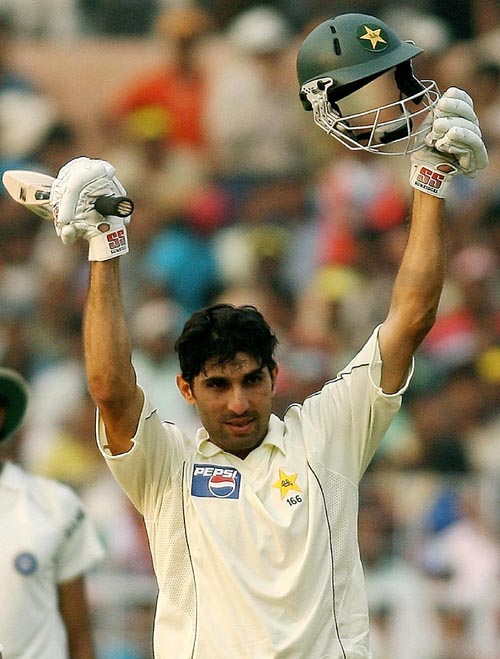
An orthodox batsman with reasonable technique, Misbah-ul-Haq caught the eye with his unflappable temperament in the tri-nation one-day tournament in Nairobi in 2002, scoring two fifties in three innings, including one in the final against Australia. But before Pakistan could hail him as a possible middle-order mainstay, Misbah's form slumped - he didn't manage a single 20-plus score in three Tests against Australia and was duly dumped. Pakistan's abysmal World Cup campaign - and the wholesale changes to the team in its aftermath - gave Misbah another chance to redeem himself, but he did little of note in the limited opportunities he got.
Even though Misbah had not represented Pakistan for about three years, a run-filled domestic season, followed by club cricket in England, and Inzamam's retirement from ODIs prompted the board to award Misbah a central contract in July 2007. A month later, he was surprisingly picked, ahead of Mohammad Yousuf, for the 15-man squad for the Twenty20 World Championship in South Africa. He repaid the selectors' faith by finishing the tournament as Pakistan's best player and nearly taking them to victory in the final. He was duly named in the team for the Test and ODI series that followed against South Africa.
After an unremarkable series against South Africa, Misbah was by far Pakistan's best batsman through the Tests against India, amassing 464 runs in three matches, including two centuries. He was ice-cool in crisis, rescuing Pakistan on several occasions with spirited rearguard efforts. His remarkable rise continued as a mere six months after being picked for the ICC World Twenty20, he was made vice-captain and handed a top-category contract in January 2008. His form deserted him again in 2009, and he dropped from all three squads for the series against New Zealand - but made yet another return to the side in October 2010, this time as captain for the Tests against South Africa .
Misbah-ul-Haq
Misbah-ul-Haq
Misbah-ul-Haq
Misbah-ul-Haq
Misbah-ul-Haq
Misbah-ul-Haq
Misbah-ul-Haq
Misbah-ul-Haq
Misbah-ul-Haq

Misbah ul Haq Brilliance


MUHAMMAD HAFEEZ

Muhammad Hafeez Biography


An opening batsman and a handy offspin bowler, Hafeez was one of the young players that the Pakistan selectors turned to after the team's abysmal display in the 2003 World Cup. His performances in Sharjah and in the NatWest Challenge in England indicated that Hafeez could well be a long-term prospect - he showed good technique and temperament at the top of the order and bowled his offspinners tidily, but most impressive was his performance in the field. Patrolling the point and covers region with feverish alertness, he saved plenty of runs and pulled off an amazing catch. His organised approach towards batting ensured that he got an opportunity in the Test team in the three-Test series against Bangladesh. He didn't do badly either, scoring a half-century on debut, and then stroking his first hundred in his second Test. However, his form then dipped alarmingly in the ODIs against South Africa, leading to his exclusion from the Test squad. Soon after he was dropped from the ODI squad as well. He has remained on the fringes of the national squad however with a string of impressive domestic performances, coupled with useful hands for the Pakistan A squad. He was called back to the ODI side in 2005 but failed to achieve any significant results. A spanking century for Pakistan A against Australia A in the Top End Series in Australia during the summer of 2006, allied with the exacerbtion of Pakistan's opening problems on the tour to England, meant that Hafeez returned for the Oval Test annd amidst all debris, his calm and signficant 95 was all but forgotten. He has been adequate rather than spectacular though given the problems Pakistan have with openers, Hafeez is likely to remain involved for some time even with an ordinary average.
Muhammad Hafeez
Muhammad Hafeez
Muhammad Hafeez
Muhammad Hafeez
Muhammad Hafeez
Muhammad Hafeez
Muhammad Hafeez
Muhammad Hafeez

Mohammad Hafeez 115 vs NZ


Mohammad Hafeez bolds Ricky Ponting

YOUNIS KHAN

Younis Khan Biography
Younis Khan is fearless, as befits his Pathan ancestry and will forever be remembered as the second Khan to bring home a world title for Pakistan: Younis was Pakistan's captain in the 2009 World Twenty20, leading a successful campaign with stark similarities to the one Imran Khan had led 17 years earlier. Younis retired from the format straight after, a graceful and dignified gesture from a complex but honest man.
It is as a batsman, and a fearless one, that he made his name first, playing with a flourish. He is especially strong in the arc from backward point to extra cover. He is prone to getting down on one knee and driving extravagantly. But this flamboyance is coupled with grit.
Though Younis was one of the few batsmen who retained his place in the team after Pakistan's disastrous World Cup campaign in 2003, he lost it soon after due to a string of poor scores in the home series against Bangladesh and South Africa. He came back for the one-day series against India, but failed to cement a place in the Test side. He is among the better fielders in Pakistan and he took a world-record four catches in one innings as substitute during Pakistan's demolition of Bangladesh in the 2001-02 Asian Test Championship.
But until his return to the side in October 2004, he wasn't a fixture. At the pivotal one-down, against Sri Lanka in Karachi, a century laid the groundwork for his emergence as a force in Pakistan cricket. He was the top run-getter in the disastrous 3-0 whitewash in Australia immediately after and on the tour of India, for which Younis was elevated to vice-captain, he blossomed. After a horror start to the series he came back strongly, capping things off with a match-winning 267 in the final Test. He credits the late Bob Woolmer, to whom he was close, for the turnaround in his career.
Since then, barring minor troughs such as the 2005-06 series against England at home, his career has been one elongated peak, scoring hundreds against India and England for fun and becoming Pakistan's most successful one-down in recent memory. More importantly, the tour to India also showcased his potential as a future captain of Pakistan and his energetic and astute leadership has impressed many people. As captain in Inzamam's absence he led the side to a disastrous loss against the West Indies in 2005 but also to a memorable win against India in Karachi in January 2006.
He blotted his book by suddenly resigning from the captaincy in Inzamam's absence for the Champions Trophy 2006, only to return a day later and lead a scandal-afflicted side to a disappointing first round exit. He was the favourite to take over the captaincy after Pakistan's ignominous World Cup ouster in 2007 but he turned it down, citing mental strain and decided to honour his commitment with Yorkshire by making himself unavailable for Pakistan. In January 2009, however, the PCB came calling a third time, after Pakistan's disastrous home ODI series against Sri Lanka, and appointed him captain in place of Shoaib Malik. Within a few months, with the Twenty20 win, Younis was looking a natural leader.
But the peace, once again, did not last long and several senior players in the team expressed misgivings over Younis' leadership. Things came to a head against New Zealand in Sharjah, after which he announced his resignation from the top-job and sought a break from the team for the tour down under. He was included in the ODI team, midway through a disastrous tour, but struggled for form and runs. His career hit its biggest controversy in March 2010 when, along with Mohammad Yousuf, he was banned by the PCB from all Pakistan teams, for causing infighting within the team, in effect ending his career.
Younis Khan
Younis Khan
Younis Khan
Younis Khan
Younis Khan
Younis Khan
Younis Khan
Younis Khan

Younis Khan 101(109)-England vs Pakistan 


Younis Khan 117 v India


SHOAIB AKHTAR

Shoaib Akhtar Biography
From the moment Shoaib emerged on the scene in the late 90s, the world knew it was in for some career. First there was the extreme pace and there was also the attitude; Shoaib was the fastest bowler in the world, he knew it, he made sure others knew it. He was a natural successor to the legacy of Imran, Wasim and Waqar. But that he will end his career an 'if only' or a 'coulda been' is the great tragedy. He had it all and he blew it.
What he had was remarkable. Early on, in 1999, there wasn't a more thrilling sight in the world than Shoaib hurtling in off an impossibly long run and beating the world's best batsmen for pace. Rahul Dravid and Sachin Tendulkar were clean bowled off successive deliveries at Eden Gardens and the World Cup in England later in the year was all but Shoaib's.
Other peaks came intermittently, but from 2004 to 2006, he rediscovered a spark; the trophy was the home series win over England in 2005-06 in which he took 17 wickets. By this time not only was he still very, very quick, but he had become an extremely smart bowler, an oft-underrated aspect of his development.
But it was a false dawn and a last hurrah. In between whiles and after, there have been as many lows. The list of misdemeanours is impossibly long; doubts about his action, ball-tampering offences, beating up his own team-mates, courtroom battles against his board, long bans and heavier fines, serious career-threatening injuries and most damagingly, doping charges. In his time, he missed more than half of the Tests Pakistan played.
So much so that what he did on the field had long ago ceased to matter and has been eclipsed by his scrapes off the field. For any sportsman, that is a damning indictment.
Shoaib Akhtar
Shoaib Akhtar
Shoaib Akhtar
Shoaib Akhtar
Shoaib Akhtar
Shoaib Akhtar
Shoaib Akhtar
Shoaib Akhtar

Shoaib Akhtar's Best in IPLIndian Premier League


Shoaib Akhtar 4_43